Call us 800-410-6580

Best air ride 5th wheel hitches: 2026 buyer's guide
Picture this: you've just wrapped up a 400-mile haul across I-10, your lower back is staging a protest, two cabinet doors in the trailer have rattled loose from their hinges, and your truck cab sounded like a maraca the entire way. That's not bad driving. That's what happens when every bump in the pavement transfers directly through a rigid coupling and into both your trailer and your spine. If you're ready for a real fix, an air ride 5th wheel hitch is the engineering solution to that exact problem. Instead of a hard steel connection between your truck and trailer, you get a carriage suspended on pressurized airbags that absorbs road shock before those forces ever reach the trailer frame or your cab.
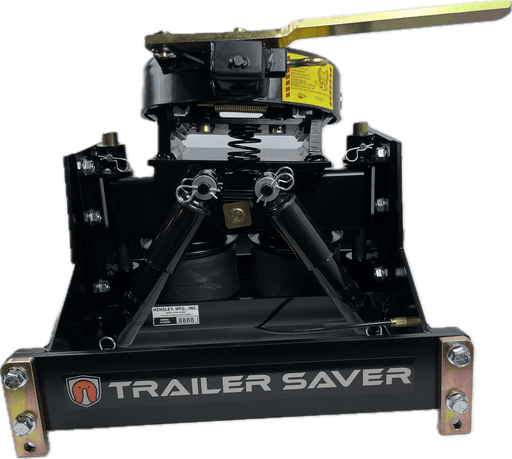
The performance gap between a rigid hitch and a true air-ride unit is significant. The TrailerSaver lineup from Tow Safe is engineered to absorb the vast majority of road shock, a difference that fundamentally reframes what "smooth towing" means.
This guide covers how these hitches work, who gets the most value from upgrading, which specs to match before buying, and which models deserve serious consideration for 2026.
How an air ride 5th wheel hitch actually works
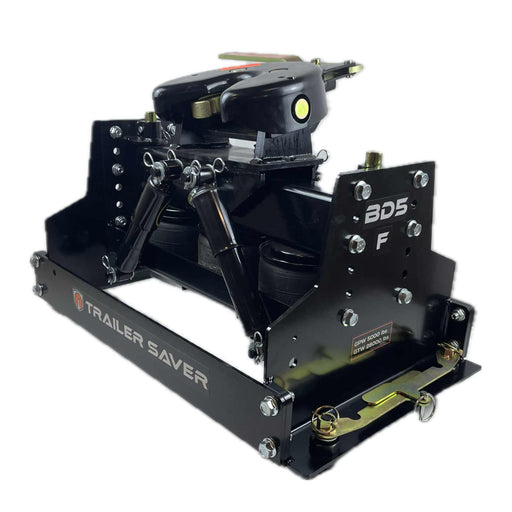
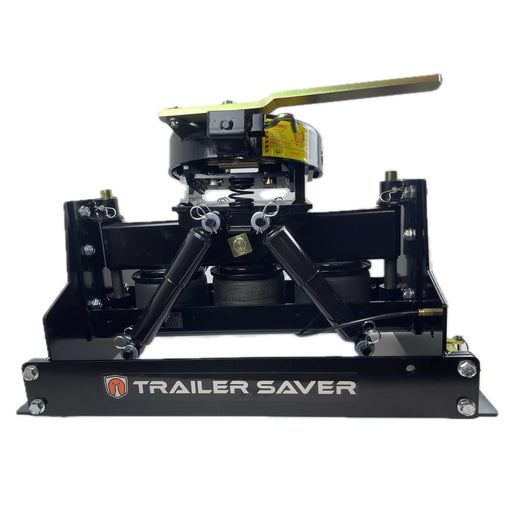
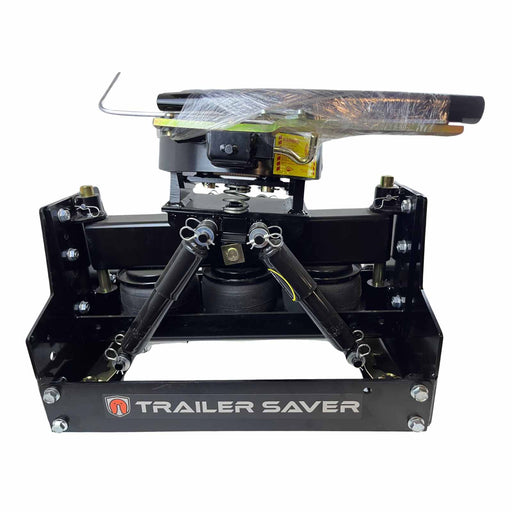
The core concept is simple: instead of the kingpin locking into a rigid steel frame, it connects to a carriage that floats on one or more airbags. When the road throws a pothole, expansion joint, or rough patch at your rig, the airbag compresses and rebounds rather than transmitting that force straight into the trailer frame and up through the cab. The result is a hitch that moves with the road rather than fighting it.
Quality designs, like the TrailerSaver models, pair that airbag system with a 4-way pivoting hitch head. This allows the connection point to flex side-to-side and fore-aft simultaneously, which matters on crowned highways, uneven campground surfaces, and tight turns where a rigid connection would bind and concentrate stress at the coupling.
The airbag system and why air pressure matters
Air pressure in the bags is adjustable, which gives you real control over ride behavior. Run lower pressure and you get a softer, more compliant ride that's ideal on rough pavement with a lighter trailer. Increase pressure and the system firms up to handle heavier pin weight without the carriage bottoming out under load. Mechanical isolators simply can't provide the same full suspension range and adjustability that an airbag system delivers. For a closer look at how the TrailerSaver suspension functions in practice, see the manufacturer's demonstration of how the system works: how TrailerSaver air-ride hitches work.
What a 4-way pivot adds to the equation
Multi-axis pivoting protects both the trailer frame and your truck bed from stress concentrations that build up over miles. On crowned roads, the coupling naturally tilts without binding. On uneven campground pads, the hitch absorbs the angle rather than transferring it as a torque load into the pin box. Over thousands of miles, that difference shows up in the structural integrity of your trailer.
Air ride vs. standard hitches: the difference you feel on the road
Most fifth-wheel owners start with a fixed hitch. A fixed hitch is exactly what it sounds like: a rigid steel connection that passes road forces directly through the coupling with almost no absorption. An air-ride hitch suspends the load on pressurized bags and actively absorbs both vertical bounce and fore-aft chucking. That's the push-pull motion you feel during acceleration and braking, and eliminating it is where a true air ride 5th wheel hitch earns its price tag.
What high road-shock absorption actually means in practice
The TrailerSaver's road shock absorption capability translates to real-world outcomes most owners notice quickly. Cabinet contents stop rattling. The truck cab gets dramatically quieter. Over the long haul, reduced frame stress means less cumulative fatigue on the trailer's structural joints, slideout hardware, and fasteners, outcomes consistent with what engineers expect when you intercept shock at the hitch rather than letting it travel through the entire structure. It's not just about comfort; it's about protecting a six-figure investment in your trailer. For a deeper discussion of the advantages an air-ride system provides, see the Hensley article on the advantages of an air ride 5th wheel hitch.
Why rubber cushion and pin boxes fall short for long-haul towing
Pin boxes are a reasonable budget compromise if you tow occasionally over smooth highways. Where they fall short is in sustained performance under high pin weights and over long distances. Rubber cushion compress and fatigue over time. Springs have a fixed rate that can't adapt to load changes. For full-timers or owners of heavy luxury fifth-wheels, those limitations accumulate into real wear on both the hitch components and the trailer itself.
Who benefits most from upgrading to air ride
Not every RV owner needs this upgrade, and being honest about that is worth more than a hard sales pitch. The buyers who consistently see strong returns on an air-ride fifth-wheel hitch share a few common traits: they're logging serious mileage, hauling heavy loads, or regularly tackling rough road conditions. Full-time RVers putting down 20,000 or more miles per year, heavy-duty truck owners towing 25,000-plus-pound luxury fifth-wheels and toy haulers, and long-distance weekend drivers who regularly cross rough highway sections or mountain passes all fall into that category. If that describes your situation, the math works in your favor.
The toll that rigid towing takes over thousands of miles
Road shock damage is a fatigue problem, not a single-event problem. Each bump adds a small load to the trailer frame, the pin box welds, the slideout hardware, and the cabinet hinges. Over tens of thousands of miles, those loads accumulate into loose hardware, stress cracks at joint points, and premature wear in the slideout mechanisms. Intercepting that shock at the hitch is one of the most effective ways to protect your trailer's structural longevity, and it's a protection strategy that compounds with every mile you drive.
When a standard hitch is probably fine
If you tow a lighter travel trailer a handful of times per year on well-maintained highways, the cost of a premium air suspension hitch likely doesn't pencil out.
Specs and compatibility: what to match before you buy
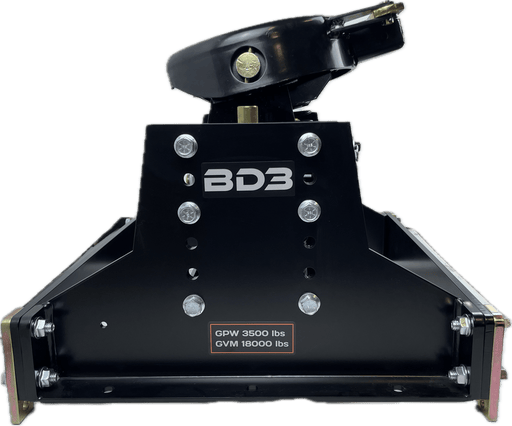
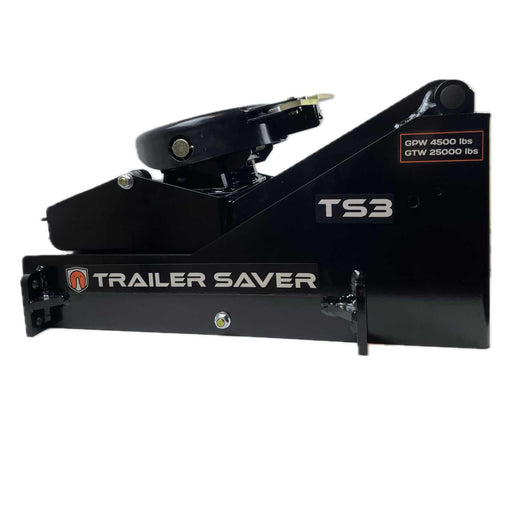
Two specs are non-negotiable before any purchase: gross trailer weight (GTW) and pin weight capacity. The TrailerSaver lineup spans a wide range of working loads, giving you a clear step-up path as trailer weight increases. The BD3 handles 18,000 lb GTW and 3,500 lb pin weight. The TS3 steps up to 25,000 lb GTW and 4,500 lb pin weight. The BD5 reaches 28,000 lb GTW with a 5,000 lb pin weight rating. At the top of the range, the heavy-duty TSLB is rated for 32,000 lb GTW, with an optional third airbag that pushes pin weight capacity to 7,500 lb. All models offer 4 inches of suspension travel. Match those numbers to your trailer's specs, not to your budget.
OEM puck systems, under-bed rails, and aftermarket adapters
Truck mounting compatibility is where a lot of buyers get tripped up. Ford, GM, and RAM all offer factory OEM prep systems with puck-style mounting points already built into the truck bed. The TrailerSaver BD5 is designed to fit Ford, GM, and RAM under-bed systems without adapters. For trucks with aftermarket under-bed rail systems, TrailerSaver offers an underbed adapter compatible with GM, Ford, and Dodge RAM prep systems. Confirm your specific mounting system before ordering so you're not sorting out an adapter situation after the hitch arrives. See the TrailerSaver BD5 product details for the BD5's OEM compatibility and fit notes: TrailerSaver BD5 product page.
Truck payload and bed clearance checks you can't skip
Beyond GTW and pin weight, a few additional checks matter before you finalize a model choice. Start by verifying your truck's remaining payload capacity after accounting for passengers and gear, the hitch and pin weight both count against that number. Next, check the cab-to-axle measurement to confirm the hitch will position the trailer's landing gear correctly. Finally, verify that hitch height is compatible with your trailer's coupler height so the rig levels properly once connected. Skipping any of these steps is how buyers end up with a hitch that fits on paper but creates problems in the driveway. If you need guidance on selecting the right hitch or suspension setup for specialized trailers, see Hensley's piece on choosing the right horse trailer hitch.
Top air ride 5th wheel hitch models worth considering in 2026
The TrailerSaver lineup from Tow Safe is the benchmark family in this category, covering four distinct models that span part-time campers through commercial-weight operations. Each model is built for a specific buyer profile rather than being a one-size-fits-all product.
TrailerSaver BD3: the removable option for part-time drivers
The BD3's defining feature is its breakdown design: the hitch separates for storage when you're not towing, leaving your truck bed fully usable between trips. Rated at 18,000 lb GTW and 3,500 lb pin weight with 4 inches of suspension travel, it's the right entry point for weekend and seasonal campers who want air-ride performance without permanently occupying the bed. Current pricing from TrailerSaver runs $2,530 on sale (from $2,830). For product specifics and dimensions, see the TrailerSaver BD3 product page: TrailerSaver BD3 product page.
TrailerSaver TS3, BD5, and TSLB2H: matching model to load
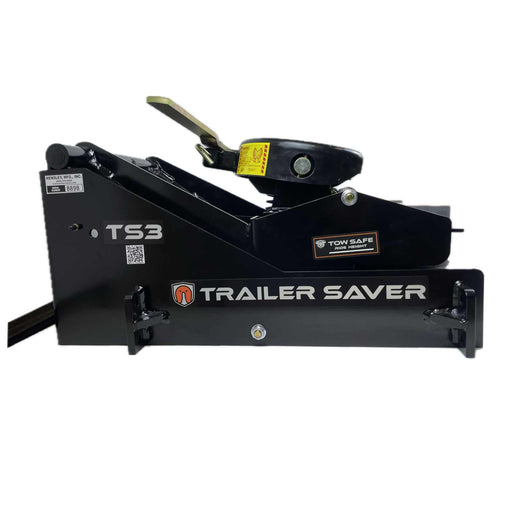
The TS3 at 25,000 lb GTW and the BD5 at 28,000 lb GTW serve serious full-timers and heavy-hauler profiles. The TS3 is a strong match for owners of large luxury fifth-wheels on 3/4-ton and 1-ton trucks. The BD5 adds direct compatibility with Ford, GM, and RAM OEM under-bed systems without adapters, making it the cleaner install for trucks equipped with factory prep. The TS3 is currently priced at $2,950 on sale (from $3,250). At the top of the lineup, the TSLB2H targets commercial-weight trailers and operators who need that optional 7,500 lb pin weight capacity. For full-time RVers and heavy-haulers, the TS3 and BD5 are the models most worth evaluating against your trailer's actual specs.
What air ride hitches typically cost and what full installation adds
Based on current retailer pricing as of mid-2026, entry-level fifth-wheel air suspension hitches start around $700 to $1,200 for the hitch alone. Mid-range units run $1,200 to $2,000, and premium models like the TrailerSaver line sit in the $2,000 to $3,500 range. While TraierSaver hitches are easy to install on your own, other hitches may need professional installation and make sure to factor that in your pricing decision.
Installation, setup, and what to expect from a professional install
There are two distinct install scenarios for air-ride fifth-wheel hitches, and they have very different complexity levels. Replacing an existing pin box with an air-ride pin box is a bolt-on swap: chock the wheels, support the trailer and old pin box, remove the existing bolts, position the new assembly, and torque hardware to spec. The catch is that pin box assemblies typically weigh 140 to 150 pounds, so two people are the minimum, and a forklift or suitable jack makes the job safer. A mechanically confident owner can complete this in a single day. For reference on pin box replacement procedures and cautions, consult manufacturer guidance when performing the swap.
Installing a full under-bed air-ride hitch system is more involved. The process starts with positioning and fastening the base rail or puck-system hardware to the truck frame, which comes before the hitch head even goes in. Professional installers on Ford F-250 and F-350 trucks typically complete this type of install in two to four hours, with factory-prep trucks sometimes running closer to three hours for a solo installer.
Tools you need and what the process looks like
For either install type, the essential tool list includes a torque wrench, socket and ratchet set, breaker bar, jack stands, and wheel chocks. Use only the hardware supplied with the kit, and torque every fastener to the manufacturer's published specification. This matters more than it might seem: these hitches carry pin weights measured in thousands of pounds, and undertorqued fasteners are how hitches develop problems at the worst possible time, when you're miles from the nearest service center.
When to hire a pro and what that costs
If your truck has a factory under-bed prep system, or if you haven't done hitch work before, a certified install is money well spent. At $300 to $900 for most setups, professional installation is a small percentage of the total investment, and it ensures the hitch is properly seated, torqued, and compatible with your specific truck configuration. Given the loads these hitches carry, a confident installation is not optional.
Making the right call for your rig
If you're towing a heavy fifth-wheel regularly, especially over long distances or rough roads, upgrading to an air ride 5th wheel hitch pays back in trailer longevity, reduced cab fatigue, and genuine riding comfort. Many owners report that the difference is noticeable quickly: the cab quiets down, the rattles stop, and the physical toll of a long haul drops considerably. That's the kind of return that compounds over every trip.
The decision framework is straightforward. Start with your trailer's GTW and pin weight. Match those to the appropriate TrailerSaver model: BD3 for part-time drivers who need a removable setup, TS3 or BD5 for full-timers and heavy haulers, and TSLB2H for the highest-capacity applications. Confirm your truck's mounting system compatibility, check remaining payload capacity, and get a professional install quote before you order.
Visit TrailerSaver to compare the BD3, TS3, BD5, and TSLB against your trailer specs and find the right air ride 5th wheel hitch for your exact setup. The team can help you confirm compatibility and connect you with a certified installer so your first long haul confirms the upgrade was worth every dollar. For local or Canadian buyers, see Hensley's Canada guidance as well: Advantages of an Air Ride 5th Wheel Hitch, Hensley (Canada).
The BD5-F Air-Ride 5th-wheel hitch fitch factory installed Ford OEM 5th wheel prep system. Designed to complement an air ride pin box, it has 28,00...
View full detailsThe TSLB 5th-wheel air-ride hitch is for medium to heavy-duty truck owners. Based on the same design as the TS3, it comes with a standard bolt-down...
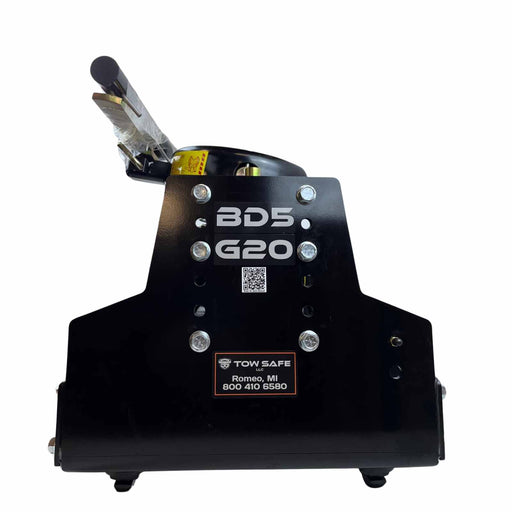
View full detailsThe BD5-G20 Air-Ride 5th-wheel hitch fitch is factory installed on GM OEM vehicles 2020 and newer. This air ride fifth wheel hitch has a 28,000 lb ...
View full detailsThe BD3 Air-Ride hitch is for weekenders and anyone who prefers to keep the hitch out of their truck when not towing. The BD3 breaks down into two ...
View full detailsThe TS3 Air-Ride fifth-wheel hitch set the standard for 5th-wheel hitches when it was introduced over 10 years ago. And it still sets the standard....
View full details
{"one"=>"Select 2 or 3 items to compare", "other"=>"{{ count }} of 3 items selected"}